What Happens When We Shame & Judge a Generation For Growing Up in a Completely Different Time?

Megan Gerhardt • January 5, 2025

What Happens When We Shame & Judge a Generation For Growing Up in a Completely Different Time?

Last week, the Wall Street Journal published a provocative opinion essay entitled What Happens When a Whole Generation Never Grows Up? 


In case you can’t get behind the paywall, the gist of the article is that the entirety of the Millennials (that’s over 72 million people in the US alone) are in a permanent state of what the article called “arrested development” because they are not reaching traditional milestones of adulthood (for those playing along at home, those would be getting married, having babies, and buying houses). Sigh. The Atlantic ran a similar article 4 years ago (entitled Why Millennials Can’t Grow Up), and I hated that one too. The Atlantic used this same set of benchmarks to judge the older Millennials (I will never use the phrase “elder Millennial”) in their 2021 article, and this WSJ take tells us this is still the case as the youngest Millennials approach 30 this year.


Where shall I begin?


I think we can all agree that the phrase “grow up” is a loaded one:


“You need to grow up!”


“Are you ever going to grow up?”


The phrase “milestones of adulthood” paints maturity as an objective concept anchored in the rites of passage of marrying, purchasing a home, and having children. Yes, for past generations, those have been common benchmarks that occur as one passes through life, but the article is based on what I consider a number of flawed premises. First, the assumption that not checking those boxes represents some personal failure and symbolizes a lack of maturity. Second, the assumption we are anchored to a static definition of growing up and adulthood.


The trusty dictionary told me the definition of grow up (verb) is: 1) to reach maturity; become adult or to
2) come into existence; develop. Even these descriptions, like growing up itself, are subjective. What it means to “mature” and the milestones we choose to use to mark this rite of passage have always changed over time.


In the book The Way We Never Were, author Stephanie Coontz notes: “In 1900, 120,000 children worked in Pennsylvania mines and factories; most of them had started work by age eleven.” One hundred and twenty-five years later, our social norms on child labor have evolved to the point where we have formulated them into law, not wanting 11 year-olds working anywhere, much less the in the mines.


According to researchers Elizabeth Fussell and Frank Furtzenberg, “the transition to adulthood has become more complex in the latter half of the twentieth century…As more young people, regardless of gender, race, or nativity, participate in secondary education through their teens, young people leave home at later ages. Furthermore, the norms surrounding the appropriate age for marriage and childbearing have changed radically over the century.”


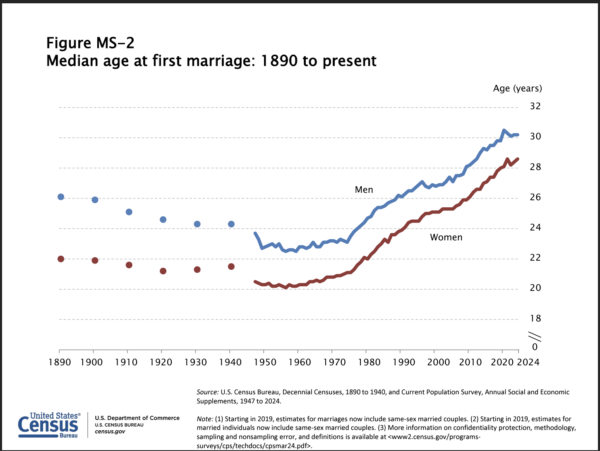
Let’s rewind just 55 years to 1970. The average age for a woman to marry was 21, for men it was closer to 23.


Fast forward to the year 2000. The average age of marriage has increased to about 25 for women, and 27 for men.


A trusty trip over to Census.gov gives us a big picture:
Median Age Grapgh

If we insist on using a static definition of growing up (i.e. getting married around the same age as the past generation) it appears those pesky kids have been refusing to grow up for a very long time. With the exception of some outliers around the end of WWII and an interesting spike in age during 2020 (thanks COVID), the average age of marriage has been steadily trending up for the past 100 years. But those outliers are important, as they demonstrate that context and life events matter, and that “growing up” doesn’t occur in a vacuum, but rather is the result of the social and economic forces at work during our lifetime.


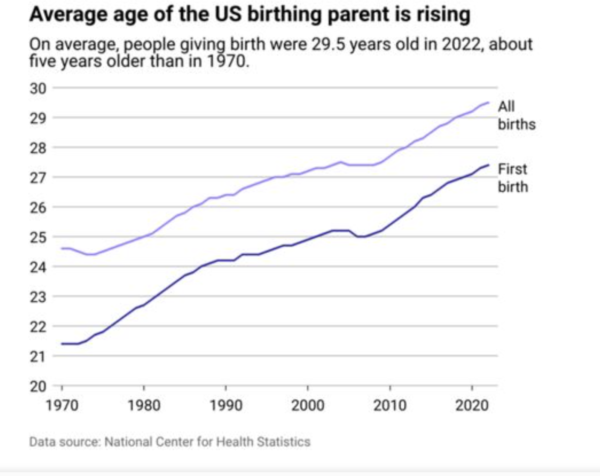
The average age to have a child has also gone up steadily over time as well. The average age for a woman to have her first child was just over 21 years of age. By 2000, that rose to 25 years.
birth ages

Let’s check out homeownership. Apparently this is important to be a grown up. This data was harder to find. According to marketplace.org, in 2023 the average age of a first time home buyer was 38, up from 35 in 2022. In 1981, the average age was 29 (I was able to dig back to 1970, where the average age was 30.6). So again, we see an upward trend line due to all kinds of important contextual factors that would have impacted the ability or desire of a young adult to purchase a home. Affordability. More young people going to college. Increases in school loan debt.


I think you get the picture. Through this lens, the Millennials don’t have a unique Peter Pan complex. They are following a long trend where these vestiges of “adulthood” are happening later, if at all.


They are up against some challenging economic realities meaning that those that may feel otherwise ready to purchase a home or get married may not feel it’s economically possible (or responsible) to do so. Mix in concerns about things like climate change and sustainability (more important for younger generations, according to the Pew Research Center), and many Millennials are thinking more carefully about whether or when they want to have children.


There is an argument to be made that waiting (or deciding not) to purchase a home or to have a child until it is more economically feasible is the definition of mature. If as a society we are concerned about the impact of a smaller population, we would need to address the fundamental reasons why these norms have shifted over time, rather than cast judgment on those navigating those waters in real time.


Gentelligence® reminds us that every generation must navigate the realities of their own time. What it means to “mature” for a particular is dependent on what is realistically possible and desirable during their time in history, a phenomenon influenced by formative events and social, economic, political, and cultural realities during that era. To judge a generation based on norms from an earlier one is not helpful, it’s just tone deaf. This is how polarization occurs, and this is why we are failing to embrace generational differences as beneficial. Criticism and judgment results in polarization, while curiosity can lead to constructive conversations and meaningful change.


By Megan Gerhardt February 13, 2026
It has been said that everything old becomes new again on a long enough timeline. There's a fascinating generational trend I've been seeing among younger Gen Zs and the oldest of Gen A (Note: I am not calling that generation Gen Alpha, because that name is nonsensical and outdated already, and that generation is barely in their teens. More on that soon)--a craving for low-tech, no-tech, screen-free experiences. Gentelligence focuses primarily on generational dynamics in the workplace, and I do predict this will have implications for where and how these generations want to work. Despite the chaos surrounding back-to-office policies and experiments, our youngest members of the workplace (and our soon-to-be newest employees) are showing signs that they value time away from screens. I first noticed this last year among my own students, who were overwhelmingly setting change goals in my change management class focused on reducing screen time. Versions included "cleaning up my sleep routine" (putting the phone away at least 30 minutes before bed, eliminating blue light before bed, reading physical books), "reduce my weekly screentime", "stop doomscrolling", and "impose limits on TikTok and Instagram time". It was a sign that it was no longer just their parents or older generations who wanted them off their phones; they wanted themselves off their phones, too. For a wave of young people raised in an era of tech overload, it seems we have reached the point of maximum saturation, and they are pushing back. As one of my students astutely mentioned to me last year, "There are no boundaries now...our generation is just trying to figure out how to put some of them back." I've doubled down on the need for this in my teaching, having conversations with students about how to ethically use AI as a thought-partner while balancing protected time for our most scarce resource these days: deep thinking and connection. It was this need, coupled with the overwhelming research showing the improved retention and learning that occurs when students handwrite their notes and put away their laptops in class, that led me to declare our classroom a laptop and phone-free zone. We still use slides to guide conversations, but there are no longer 30 laptop screens popped up in front of them, distracting even those who are trying hard to focus. Surprisingly, I've had very little pushback. I was concerned they would feel like I was forcing them backwards, but collectively we seem to be exhaling. The discussions have never been better. As our younger Gen Zs reach young adulthood and our oldest Gen As become teenagers, they are emerging from a kind of social experiment they entered unwittingly — a life that has never known a world without constant screens. They are realizing how different they feel when they unplug. Gen Z and Gen A even have a term for this: touching grass. That's right, when the default is constant tech immersion, they had to come up with a phrase to represent the intentional effort it takes to step away. Whenever possible, I try to engage in some real-time generational anthropology, just to explore my hunches and (when possible) debunk stereotypes. Gentelligence is all about being curious rather than judgmental, and I am most definitely curious about these early signs that our younger generations are seeking a better balance between their tech and non-tech worlds. Last month, I was in Chicago for a keynote and found myself in a trendy food hall over lunch. There were little shops surrounding the food hall, including one of my all-time weaknesses, a stationery store . Pens! Journals! Paper! Notebooks! (I, too, love the analog. After indulging myself in a number of vital paper goods, I was tucking into a sandwich in the food hall and saw a (literally) noteworthy sight: a table of early 20-somethings, gathering on their lunch hour and...writing in their journals. Multi-colored pens, stamps, and conversation were plentiful. There was not a phone in sight. That in and of itself was remarkable. It turns out that stationary stores are experiencing a resurgence . Knitting, crocheting, embroidery, and sourdough baking are also all having a moment. Physical books ( and bookstores! ) are making a comeback. A few weeks later, I was at another event, this time a very trendy commercial interior design conference, where we were discussing ways to design spaces that promote intergenerational interactions (yes, it was as cool as you might be thinking). I saw a young designer at the cocktail hour and walked over to introduce myself. I asked if I could pick her brain on something, as I figured it was part of her JOB to be up on the latest trends. I asked her whether she was feeling a personal pull to use less tech, or if this was something she had seen among her peers. That's when she told me about Analog Bags . (I won't go down that rabbit hole here, but feel free to explore the link and know that I am absolutely creating my own Analog Bag as we speak). At that same design conference, a book was recommended to me: Megatrends by John Naisbett. The gentleman who suggested it said it changed his life. He thought I would find it interesting, given my interest in generational trends, behavioral cycles, and, of course, my classes in change management. I ordered it as soon as I got back to my hotel room (fun fact: it was published in 1982, so you'll have to find a vintage copy!). I've been devouring it, and among the many eye-opening insights was the observation that " the more 'High Tech' we become, the more we need 'High Touch.” Now, Naisbett was referring to the high-tech era of the early 1980s, when personal computers were entering the scene, but the relevance of the comment almost 45 years later, in the age of AI, was not lost on me. Those who have lived their entire lives as products of high-tech are now blazing the trail to meet their need for high touch. Let this be my formal declaration (for whatever it's worth) that I predict our youngest generations will lead us back to a balance between tech and high-touch: they are the proverbial canaries in the coal mine, and their message is clear. They are living, breathing embodiments of a life flooded with endless tech, fake news, constant connectivity, dopamine hits, and input dictated by algorithms, and it appears they may have had enough.
By Megan Gerhardt January 12, 2026
What if every generation is trying to be respectful, but what that means is entirely different depending on when you grew up?
By Megan Gerhardt November 16, 2025
Explores how AI thinks different generations write emails
By Megan Gerhardt September 12, 2025
Curse of Knowledge: experts can't imagine not knowing what they know. In workplaces, generations assume others share their experience, causing miscommunication.
By Megan Gerhardt August 31, 2025
Maybe i do too.
By Megan Gerhardt July 13, 2025
It wasn't a planned comment.
By Megan Gerhardt May 19, 2025
I've always loved invisible ink.
By Megan Gerhardt May 6, 2025
the plot thickens.
By Megan Gerhardt April 10, 2025
The difference between multigenerational workforce and intergenerational workforce and why it matters.
By Megan Gerhardt March 25, 2025
Here's the thing about water.