Pete Buttigieg, Pilots, and the Continuing Myth of the Zero-Sum Age Game

Megan Gerhardt • July 20, 2022

In case I wasn’t clear the first time, I am not in favor of raising the mandatory retirement age for pilots to 67. I am in favor of not having a mandatory retirement age at all because that is ageist.

Apparently, this conversation on mandatory retirement age for pilots is far from over. Usually, I dig into age-related challenges in a particular industry, view them through a Gentelligence lens, and try to raise important questions for consideration. That’s what I tried to do a few weeks ago when the role of mandatory retirement in the pilot shortage was in the news, with the thought that I would weigh in and then move on to other industries and other questions. But the calls keep coming in on this one, and it seems important to keep the conversation going.


Pete Buttigieg & the Zero Sum Game
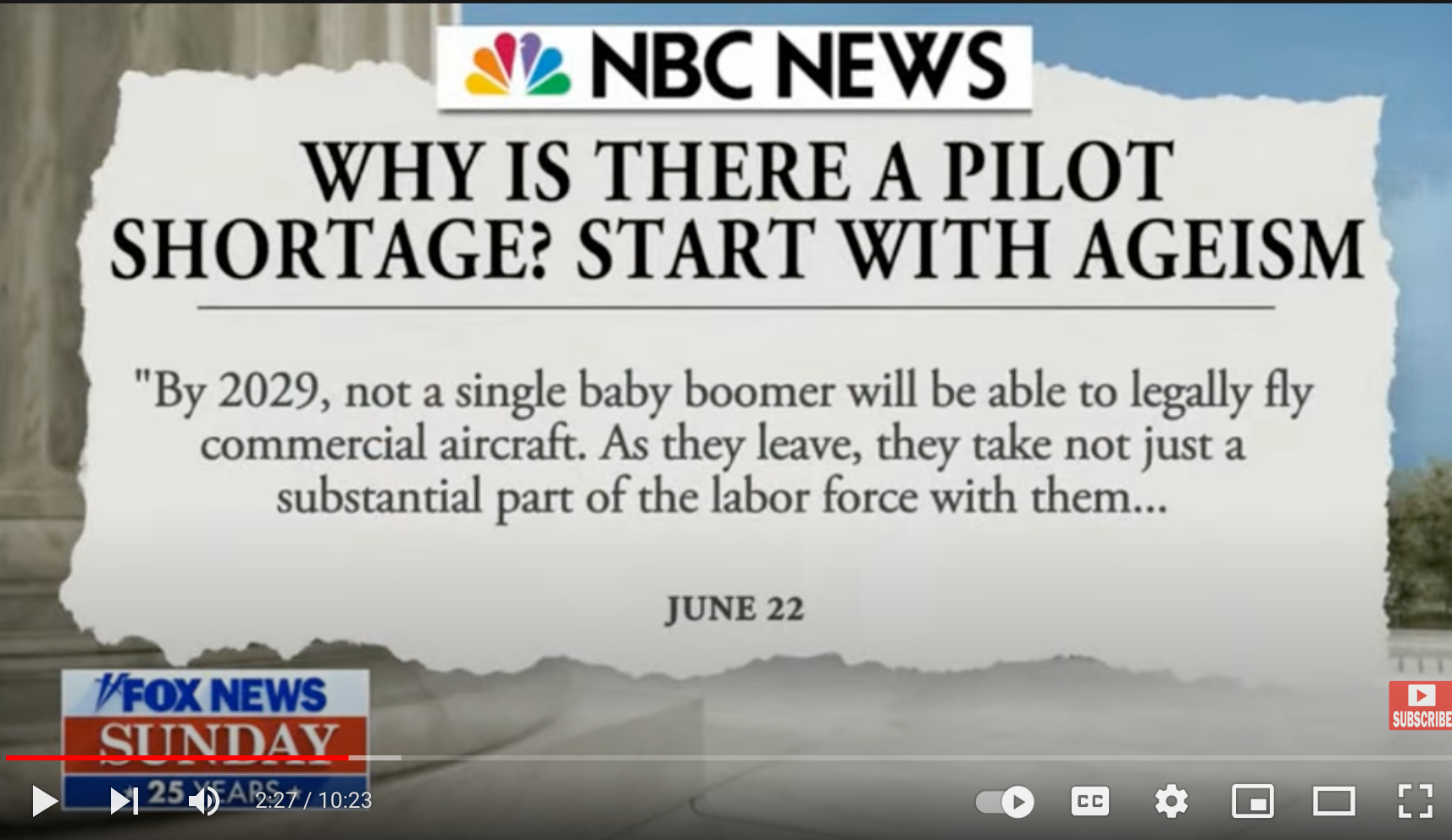
Headline image on NBC news-

On July 11, Fox News shared an excerpt from my recent NBC piece during an interview with Transportation Secretary Pete Buttigieg. The host raised the question about the wisdom of the mandatory retirement age of 65 for commercial pilots, a rule that would result in no Baby Boomers being eligible to fly by 2029. Buttigieg responded, “The answer is not to keep the baby boomer generation in the cockpit indefinitely. The answer is to make sure that we have as many and as good pilots ready to take their place to have a stronger pipeline.”


And here, friends, is where we see the Myth of the Zero Sum Game in its’ full glory.

Allow me to define a zero-sum game: “A situation in which one person or group can win something only by causing another person or group to lose”.

A false dichotomy is being presented here: that either we allow pilots over the age of 65 (who yes, have passed their health checks) continue to fly, OR we invest in the development of the “new generation” of pilots. This doesn’t have to be an either-or situation. The problem is that it is being presented that way, and creating the illusion that there are just these two choices.


Happy 65th Birthday, Pilots!


The goal of Gentelligence® (and, I hope, the airline industry) would be to fully engage our talent across all generations, providing the training and opportunities needed to welcome younger people into the profession but not kicking pilots with decades of valuable experience out of the plane on their 65th birthday because of mandatory retirement age.

Why are these things being seen as mutually exclusive? A past student of mine sent me this Instagram video recently, showing the clear “us vs, them” mindset that is driving this tension.


Research (and interviews with the many pilots that have called me after this story) reveals that the way opportunities are given in the airline industry is based on seniority. According to ATP Flight School, “Seniority is everything as an airline pilot.”  The Aircraft Owners and Pilots Association Foundation concurs: “You’ve probably heard the saying, “seniority is everything.” Well, in the airline piloting business, that’s absolutely correct.”  For an industry that puts so much value on seniority over all else, it seems quite odd that this reverence for experience abruptly ends at 65, full stop.


If the System is Broken…Fix It


Therefore, the perception is that if older pilots continue to fly, they somehow stand in the way of younger ones being able to get the training hours they need and better routes they crave. If the way opportunities are granted creates the perception that it pits older against younger, then it’s the process that is the problem. A system that always prioritizes more senior people is also potentially ageist, just in the other direction.


However, based on my interviews with a number of pilots, it’s not quite that simple. Older pilots have shared that there are plenty of routes and opportunities to go around, especially with so many planes grounded at the moment because there is no one qualified to fly them. It’s also important to note that “seniority”, while correlated with age, is also not specifically about age, but rather your tenure with a specific airline. Things like mergers and the age at which you began with the airline can mean that younger people can (occasionally) have seniority over older pilots.


The solution to a dysfunctional process isn’t to force people to retire based on an arbitrary age to create more opportunities for younger people. And it’s not to deny needed opportunities to younger people to retain the older ones. The answer is somewhere in the middle, in a mutually beneficial approach that balances these needs and interests.


This is the goal Gentelligence Practice #4: Expand the Pie. Can younger pilots win without older ones losing, or vice versa? What would that look like, and why aren’t we focusing on that as a solution?


I would argue this is not unique to the aviation industry. Other industries have found ways to both create opportunities for their younger professionals while retaining and engaging their older ones without a mandatory retirement age.


Remember, you can count on one hand the jobs that still are clinging to the mandatory retirement age: air traffic control. Commercial pilots. The military. Some federal judges (but not the Supreme Court), and some CPAs, depending on the firm. (Let me know if I’ve missed any, as I am putting together a chapter on this for my new book).


Every industry must balance this reality and find solutions that aren’t ageist, either in favor of older or younger people.


What solutions have worked in other fields, and how can we use them to move this discussion in a more Gentelligent direction?




By Megan Gerhardt February 13, 2026
It has been said that everything old becomes new again on a long enough timeline. There's a fascinating generational trend I've been seeing among younger Gen Zs and the oldest of Gen A (Note: I am not calling that generation Gen Alpha, because that name is nonsensical and outdated already, and that generation is barely in their teens. More on that soon)--a craving for low-tech, no-tech, screen-free experiences. Gentelligence focuses primarily on generational dynamics in the workplace, and I do predict this will have implications for where and how these generations want to work. Despite the chaos surrounding back-to-office policies and experiments, our youngest members of the workplace (and our soon-to-be newest employees) are showing signs that they value time away from screens. I first noticed this last year among my own students, who were overwhelmingly setting change goals in my change management class focused on reducing screen time. Versions included "cleaning up my sleep routine" (putting the phone away at least 30 minutes before bed, eliminating blue light before bed, reading physical books), "reduce my weekly screentime", "stop doomscrolling", and "impose limits on TikTok and Instagram time". It was a sign that it was no longer just their parents or older generations who wanted them off their phones; they wanted themselves off their phones, too. For a wave of young people raised in an era of tech overload, it seems we have reached the point of maximum saturation, and they are pushing back. As one of my students astutely mentioned to me last year, "There are no boundaries now...our generation is just trying to figure out how to put some of them back." I've doubled down on the need for this in my teaching, having conversations with students about how to ethically use AI as a thought-partner while balancing protected time for our most scarce resource these days: deep thinking and connection. It was this need, coupled with the overwhelming research showing the improved retention and learning that occurs when students handwrite their notes and put away their laptops in class, that led me to declare our classroom a laptop and phone-free zone. We still use slides to guide conversations, but there are no longer 30 laptop screens popped up in front of them, distracting even those who are trying hard to focus. Surprisingly, I've had very little pushback. I was concerned they would feel like I was forcing them backwards, but collectively we seem to be exhaling. The discussions have never been better. As our younger Gen Zs reach young adulthood and our oldest Gen As become teenagers, they are emerging from a kind of social experiment they entered unwittingly — a life that has never known a world without constant screens. They are realizing how different they feel when they unplug. Gen Z and Gen A even have a term for this: touching grass. That's right, when the default is constant tech immersion, they had to come up with a phrase to represent the intentional effort it takes to step away. Whenever possible, I try to engage in some real-time generational anthropology, just to explore my hunches and (when possible) debunk stereotypes. Gentelligence is all about being curious rather than judgmental, and I am most definitely curious about these early signs that our younger generations are seeking a better balance between their tech and non-tech worlds. Last month, I was in Chicago for a keynote and found myself in a trendy food hall over lunch. There were little shops surrounding the food hall, including one of my all-time weaknesses, a stationery store . Pens! Journals! Paper! Notebooks! (I, too, love the analog. After indulging myself in a number of vital paper goods, I was tucking into a sandwich in the food hall and saw a (literally) noteworthy sight: a table of early 20-somethings, gathering on their lunch hour and...writing in their journals. Multi-colored pens, stamps, and conversation were plentiful. There was not a phone in sight. That in and of itself was remarkable. It turns out that stationary stores are experiencing a resurgence . Knitting, crocheting, embroidery, and sourdough baking are also all having a moment. Physical books ( and bookstores! ) are making a comeback. A few weeks later, I was at another event, this time a very trendy commercial interior design conference, where we were discussing ways to design spaces that promote intergenerational interactions (yes, it was as cool as you might be thinking). I saw a young designer at the cocktail hour and walked over to introduce myself. I asked if I could pick her brain on something, as I figured it was part of her JOB to be up on the latest trends. I asked her whether she was feeling a personal pull to use less tech, or if this was something she had seen among her peers. That's when she told me about Analog Bags . (I won't go down that rabbit hole here, but feel free to explore the link and know that I am absolutely creating my own Analog Bag as we speak). At that same design conference, a book was recommended to me: Megatrends by John Naisbett. The gentleman who suggested it said it changed his life. He thought I would find it interesting, given my interest in generational trends, behavioral cycles, and, of course, my classes in change management. I ordered it as soon as I got back to my hotel room (fun fact: it was published in 1982, so you'll have to find a vintage copy!). I've been devouring it, and among the many eye-opening insights was the observation that " the more 'High Tech' we become, the more we need 'High Touch.” Now, Naisbett was referring to the high-tech era of the early 1980s, when personal computers were entering the scene, but the relevance of the comment almost 45 years later, in the age of AI, was not lost on me. Those who have lived their entire lives as products of high-tech are now blazing the trail to meet their need for high touch. Let this be my formal declaration (for whatever it's worth) that I predict our youngest generations will lead us back to a balance between tech and high-touch: they are the proverbial canaries in the coal mine, and their message is clear. They are living, breathing embodiments of a life flooded with endless tech, fake news, constant connectivity, dopamine hits, and input dictated by algorithms, and it appears they may have had enough.
By Megan Gerhardt January 12, 2026
What if every generation is trying to be respectful, but what that means is entirely different depending on when you grew up?
By Megan Gerhardt November 16, 2025
Explores how AI thinks different generations write emails
By Megan Gerhardt September 12, 2025
Curse of Knowledge: experts can't imagine not knowing what they know. In workplaces, generations assume others share their experience, causing miscommunication.
By Megan Gerhardt August 31, 2025
Maybe i do too.
By Megan Gerhardt July 13, 2025
It wasn't a planned comment.
By Megan Gerhardt May 19, 2025
I've always loved invisible ink.
By Megan Gerhardt May 6, 2025
the plot thickens.
By Megan Gerhardt April 10, 2025
The difference between multigenerational workforce and intergenerational workforce and why it matters.
By Megan Gerhardt March 25, 2025
Here's the thing about water.